

The Emma Bible Verse is a topic many Christians search for when wondering whether the name Emma appears in Scripture. Although Emma is not directly mentioned in the Bible, its meaning and spiritual symbolism offer valuable insights rooted in Christian faith.
This guide explores the Emma Bible Verse, the biblical connection to the name Emma, its meaning, related Scriptures, and spiritual significance. Discover how this beloved name reflects faith, hope, and godly character through biblical principles.
The Etymology of the Name Emma
- The name Emma originates from the ancient Germanic word “ermen” or “irmen” which carries the core meaning of “whole,” “universal,” or “all-embracing” — words that speak to completeness, fullness, and the absence of lack.
- This Germanic root is among the oldest foundations for any modern English name, tracing back well over a thousand years to the early medieval period when Germanic tribes and their languages shaped the cultural landscape of Europe.
- The meaning of “whole” in its original context was not merely physical but holistic — encompassing the idea of someone who is complete in character, fully formed in purpose, and lacking nothing essential to living a dignified and meaningful life.
- Emma shares its etymological root with related names including Erma, Emmeline, Irma, and Emily — all of which carry variations of the same core meaning of wholeness and universal completeness.
- The name Emma of Normandy, one of the most powerful women of 11th-century Europe who became Queen of England, brought enormous prestige to the name during the medieval period and established it as a name associated with strength, dignity, and noble character.
- Over the centuries, Emma has been adapted across many languages while retaining its essential meaning — German Emma, French Emma, Spanish Emma, and English Emma all share the same beautiful root and the same powerful core significance.
- The word “universal” embedded in the name’s meaning adds another dimension — suggesting someone whose warmth, love, and care extends beyond narrow personal circles to embrace people of all kinds and backgrounds with genuine openness.
- Understanding the etymology of Emma is not just an academic exercise — it is the starting point for a genuinely rich spiritual reflection, because the concepts of wholeness and universality are not peripheral biblical ideas but central ones that run through Scripture from beginning to end.
Popularity and Historical Context of the Name Emma
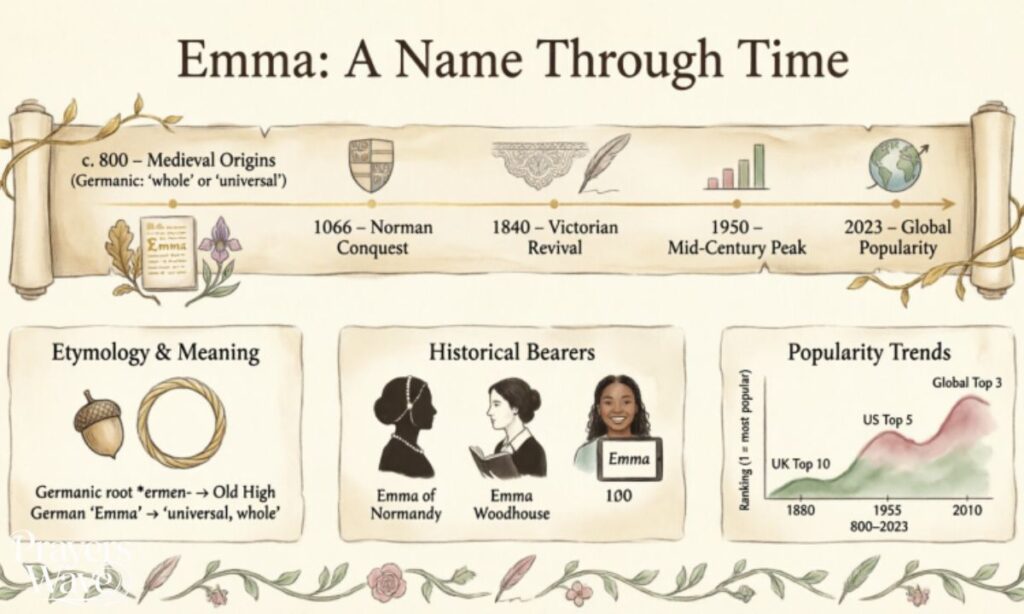
- Emma has one of the most remarkable popularity trajectories of any name in Western history — achieving prestige in medieval royal courts, enduring through centuries of cultural change, and then rising to become one of the most popular names of the entire 21st century.
- Medieval Europe saw Emma used primarily among royalty and nobility — it was a name that signaled dignity, strength, and the kind of complete personhood that made someone worthy of leadership and honor.
- Emma of Normandy (985–1052) is perhaps the most historically significant early bearer of the name — she was Queen consort of England twice, mother of two English kings, and one of the most politically influential women of the medieval period.
- Jane Austen’s novel Emma published in 1815 gave the name enormous cultural boost in the English-speaking world — the character Emma Woodhouse, despite her flaws, represented intelligence, warmth, and genuine personal growth, adding literary prestige to the name’s already considerable appeal.
- In the 20th century, Emma experienced a significant revival across Europe — particularly in the United Kingdom and Germany — as parents sought classic names that felt timeless rather than trendy.
- In the 21st century, Emma has achieved extraordinary heights — consistently ranking in the top 3 baby girl names in the United States for most of the 2000s and 2010s, and topping or nearly topping charts in the United Kingdom, Canada, Australia, and across Europe simultaneously.
- This consistent, multigenerational popularity reflects something important about the name — it is not driven by a single cultural moment, a celebrity choice, or a passing trend but by something more enduring in the name’s sound, meaning, and feel.
- Christian communities have embraced Emma with particular warmth because its meaning of wholeness and universality resonates so naturally with core biblical values — making it feel like a genuinely faith-aligned choice rather than simply a fashionable one.
Is the Name Emma in the Bible?
- The direct and honest answer is — no, the name Emma does not appear anywhere in the Bible, neither in the Old Testament nor the New Testament.
- The Bible was written in Hebrew, Aramaic, and Greek — and its names reflect the cultures of the ancient Middle East and Mediterranean world rather than the Germanic cultures of medieval Europe where Emma originated.
- This absence from the biblical text is not unique to Emma — many of the most beloved and widely used Christian names throughout history similarly lack a direct biblical address, including Grace, Faith, Trinity, Hope, and countless others.
- What matters most for a name’s spiritual significance is not whether it appears in a concordance but whether its meaning and themes align with biblical truth — and Emma’s meaning passes this test with remarkable comprehensiveness.
- The concept of wholeness is one of the Bible’s most consistent and important spiritual themes — from the Hebrew word shalom (peace/wholeness/completeness) to the Greek word teleios (mature/complete/lacking nothing), Scripture consistently presents wholeness as God’s desire for His people.
- The concept of universality is equally biblical — from Genesis 12:3 where God promises Abraham that all nations will be blessed through him, to Revelation 7:9 where people from every nation, tribe, and tongue stand before God’s throne, the universal scope of God’s love is one of Scripture’s most consistent and celebrated themes.
- Christian parents who name a daughter Emma are therefore not choosing an unbiblical name — they are choosing a name whose core meaning speaks directly to two of the Bible’s most central and most beautiful spiritual themes.
- The question worth asking about any name is not “does it appear in Scripture?” but “does it reflect God’s character and invite the bearer toward His purposes?” — and Emma answers that question with a confident and well-supported yes.
Biblical Analogies and Themes Connected to the Name Emma
- Although Emma has no direct scriptural presence, its meaning creates powerful resonance with specific biblical themes, specific biblical characters, and specific biblical promises that illuminate the name’s spiritual depth considerably.
- The Hebrew concept of shalom is perhaps the most direct biblical parallel to Emma’s meaning of wholeness — shalom does not mean merely the absence of conflict but a comprehensive state of completeness, harmony, provision, and right relationship with God and others.
- The Greek word teleios used throughout the New Testament — meaning mature, complete, and lacking nothing — is another direct parallel, appearing in James 1:4, Matthew 5:48, and Colossians 4:12 to describe the spiritual completeness God desires for His people.
- Colossians 2:10 makes the connection explicit — “and in Christ you have been brought to fullness” — declaring that completeness is not achieved through human striving but received through union with Christ.
- The universal love of God expressed throughout Scripture resonates with Emma’s “universal” meaning — John 3:16 declares that God so loved the world, not just a nation or a culture, and this universality is part of Emma’s etymological heritage.
- Galatians 3:28 — “There is neither Jew nor Gentile, neither slave nor free, nor is there male and female, for you are all one in Christ Jesus” — captures the universal inclusion that Emma’s meaning points toward in its most beautiful biblical expression.
- Ruth is one of the biblical characters whose story most closely parallels what the name Emma represents — her wholehearted devotion, her inclusive love for Naomi across cultural boundaries, and the completeness she found in God’s provision make her a natural spiritual companion for the name.
- Esther also resonates — her courage, her completeness of character under pressure, and the universal impact of her faithfulness on an entire people reflect the strength and universality embedded in Emma’s meaning.
- The Proverbs 31 woman is another natural connection — described as someone of complete, wholehearted, and universally beneficial character whose “worth is far above rubies” — a portrait of the wholeness that Emma’s meaning invokes.
The Virtue of Wholeness in Scripture

- Wholeness is not a peripheral biblical concept — it is one of the most central and consistently pursued themes in the entire narrative of Scripture from the creation of a perfect world to the promise of its complete restoration.
- James 1:4 is perhaps the most direct New Testament expression of Emma’s meaning — “Let perseverance finish its work so that you may be mature and complete, not lacking anything.” — The word “complete” here is the same Greek root as teleios, meaning fully formed, whole, and lacking nothing.
- This wholeness is not the result of human perfectionism or religious performance — it is the fruit of perseverance through trials, a process by which God gradually fills every lack and forms every missing dimension of character.
- Psalm 23 reflects the wholeness that God provides — the Lord as shepherd who ensures His sheep lack nothing, who restores the soul, who leads in right paths, and who prepares a table even in the presence of enemies — this is a comprehensive picture of divine wholeness in every dimension of life.
- Philippians 4:19 promises — “And my God will meet all your needs according to the riches of his glory in Christ Jesus” — the word “all” here reflects the complete, universal provision of a God whose care is not partial but whole.
- John 10:10 records Jesus’s declaration — “I have come that they may have life, and have it to the full” — the word “full” points directly to the completeness of the life Jesus offers, a life that is whole rather than fragmented, complete rather than partial.
- The biblical picture of wholeness is also relational — 1 Corinthians 13:10 says that when completeness comes, the partial disappears, suggesting that wholeness involves the resolution of every fragmentation and the fulfillment of every spiritual longing.
- For someone named Emma, this theme of wholeness is not just a naming curiosity — it is a daily spiritual invitation to pursue the completeness that God offers through Christ and to trust Him with every place in life where brokenness and incompleteness still remain.
Universality and Unity in God’s Love
- The second dimension of Emma’s meaning — universality — connects to one of the most sweeping and consistently celebrated themes in all of Scripture: the universal scope of God’s love and the universal invitation of the gospel.
- John 3:16 is the most famous and most foundational expression of this universality — “For God so loved the world” — not a subset of humanity, not a preferred group, not people who had already made themselves worthy, but the entire world in all its brokenness and diversity.
- Isaiah 49:6 shows God expanding His purposes beyond national boundaries — “I will also make you a light for the Gentiles, that my salvation may reach to the ends of the earth” — a prophetic declaration of universal reach that the New Testament shows being fulfilled in Christ.
- Revelation 7:9 provides the ultimate picture — “After this I looked, and there before me was a great multitude that no one could count, from every nation, tribe, people and language, standing before the throne and before the Lamb” — the complete fulfillment of God’s universal love in the eternal gathering of His people.
- Acts 10:34–35 records Peter’s transformed understanding — “I now realize how true it is that God does not show favoritism but accepts from every nation the one who fears him and does what is right” — the universal acceptance of God breaking through every cultural barrier.
- The universality in Emma’s name is therefore a genuinely prophetic quality — it aligns with what God has always been working toward throughout all of human history, the gathering of a complete and universal family of faith from every corner of the earth.
- A person who carries the name Emma carries within their very name an invitation to love broadly, to welcome generously, and to reflect the universality of God’s own heart in their relationships and their engagement with the world.
How the Name Emma Relates to Faith and Strength
- The combination of wholeness and universality creates a portrait of faith-based strength that is both deeply personal and broadly oriented — strength rooted in completeness in Christ that naturally extends outward in love toward others.
- True strength in the biblical understanding is never merely physical power or forceful personality — it is the completeness of a person who is whole in their relationship with God, consistent in their character, and unshakeable in their trust.
- Isaiah 40:31 — “But those who hope in the Lord will renew their strength. They will soar on wings like eagles; they will run and not grow weary, they will walk and not be faint” — describes strength that comes from wholehearted dependence on God rather than self-sufficiency.
- Proverbs 31:25 — “She is clothed with strength and dignity; she can laugh at the days to come” — describes a woman whose strength is rooted in character and faith rather than in favorable circumstances, reflecting the wholeness that Emma’s name evokes.
- Ephesians 3:16–17 captures Paul’s prayer for the believers — “that he may strengthen you with power through his Spirit in your inner being, so that Christ may dwell in your hearts through faith” — inner strength from inner wholeness, exactly what the name Emma points toward.
- Biblical women whose stories reflect Emma’s qualities of wholeness and strength include Ruth whose wholehearted loyalty produced remarkable strength in genuinely difficult circumstances, Esther whose complete surrender to God’s purpose gave her the courage to risk her life for an entire people, and Mary whose complete surrender to God’s will produced the most significant act of faith in human history.
- For someone named Emma, these women are not just historical figures — they are spiritual companions whose stories illuminate what the name’s meaning looks like when it is fully lived out in the context of genuine faith.
- The strength Emma’s name points toward is not self-generated — it is the natural overflow of a life that has found its completeness in Christ and its purpose in His universal kingdom purposes.
Reflective Lessons From the Name Emma
- The name Emma teaches believers that wholeness is not our natural state but our destination — we begin broken, incomplete, and searching, and God’s work in us is the process of bringing us to the completeness He always designed for us.
- The lesson of universality challenges every form of narrow, exclusive, or tribal thinking — Emma’s name is a quiet rebuke to the tendency to love only the familiar, welcome only the similar, and care only for those who are easy to care for.
- Emma teaches that strength and gentleness are not opposites — the name carries both the robust meaning of wholeness and the soft beauty of a name that has been beloved for its warmth and grace across centuries of use.
- The lesson of completeness in Christ rather than in human achievement is perhaps the most practically important — Emma’s meaning points away from striving and performance and toward the completeness that is already available as a gift in Jesus.
- Emma teaches the value of enduring character over trend-following — a name that has been consistently loved for over a thousand years represents something genuinely timeless, and the virtues of wholeness and universality it represents are similarly timeless in their value.
- The lesson of spiritual maturity as process runs through the name — wholeness is not achieved instantly but grown into through the ongoing work of the Spirit, through trials persevered, through Scripture meditated upon, and through a daily surrender that allows God to complete what He began.
- Emma teaches that your name is a declaration — every time it is spoken, the meaning behind it is quietly present, and living up to the wholeness and universal love your name represents is one of the most beautiful forms of honoring the parents who gave it and the God who inspired it.
Embracing Spiritual Wholeness Through the Name Emma
- Spiritual wholeness begins with the honest acknowledgment that without Christ, we are genuinely and completely incomplete — and that this incompleteness is not a failure but an invitation to the One who fills every lack.
- Colossians 2:10 says simply and powerfully — “And in Christ you have been brought to fullness” — meaning that wholeness is not something to be achieved but something to be received and then progressively walked in.
- Embracing spiritual wholeness means surrendering the broken places honestly rather than managing or hiding them — bringing every fragment of your life to the God who specializes in making broken things whole and incomplete things complete.
- It means pursuing spiritual disciplines not as religious obligations but as the practical means by which God’s wholeness is progressively formed in a willing and open heart — prayer, Scripture, worship, community, and service all contribute to the completeness God is building.
- It means practicing wholehearted faith rather than compartmentalized faith — not keeping God in the Sunday box while other areas of life operate independently, but allowing His lordship to extend into every dimension of living.
- It means allowing trials to do their completing work — James 1:4 connects perseverance through trials to the achievement of maturity and completeness, meaning that the very experiences we most want to avoid are often the ones most essential to our becoming whole.
- For someone named Emma, embracing spiritual wholeness means living up to the declaration in their name — trusting God to complete His work, welcoming His process, and expecting the wholeness He promised to every person who surrenders fully to His transforming love.
Bible Verses That Reflect the Meaning of Emma
- James 1:4 — “Let perseverance finish its work so that you may be mature and complete, not lacking anything.” — The most direct biblical expression of Emma’s core meaning — completeness and the process by which God produces it.
- Colossians 2:10 — “And in Christ you have been brought to fullness.” — Wholeness found in Christ rather than in human achievement — the theological heart of what Emma’s name points toward.
- John 3:16 — “For God so loved the world.” — The universality of God’s love in its most famous and most complete expression — reflecting Emma’s “universal” meaning at its deepest level.
- Galatians 3:28 — “There is neither Jew nor Gentile, neither slave nor free, nor is there male and female, for you are all one in Christ Jesus.” — The radical universality of the gospel that Emma’s name reflects beautifully.
- Psalm 23:1 — “The Lord is my shepherd, I lack nothing.” — The wholeness of provision and care that God offers — a direct parallel to Emma’s meaning of completeness.
- John 10:10 — “I have come that they may have life, and have it to the full.” — Life in its fullness and completeness — exactly what Emma’s name declares as both a meaning and a spiritual aspiration.
- Ephesians 3:19 — “And to know this love that surpasses knowledge — that you may be filled to the measure of all the fullness of God.” — Being filled to complete fullness — perhaps the most magnificent biblical description of what Emma’s meaning ultimately points toward.
- Psalm 46:5 — “God is within her, she will not fall.” — A verse many parents associate specifically with daughters named Emma — the strength and security of God’s indwelling presence making a person whole and unshakeable.
- Colossians 3:14 — “And over all these virtues put on love, which binds them all together in perfect unity.” — Love as the binding agent of completeness — reflecting both the wholeness and the universality of Emma’s meaning in a single verse.
- Philippians 1:6 — “He who began a good work in you will carry it on to completion until the day of Christ Jesus.” — God’s commitment to completing His work — the promise that Emma’s meaning of wholeness will ultimately and certainly be fulfilled in every life surrendered to Him.
Practical Application — Living Out Emma’s Meaning Every Day

- Practice wholehearted surrender daily — Emma’s meaning calls for the kind of complete, whole-person devotion that holds nothing back from God, and this wholeness is built one daily surrender at a time rather than achieved in a single moment of decision.
- Extend universal welcome — let the universality embedded in your name challenge you to love more broadly, welcome more generously, and reflect God’s all-embracing heart in every relationship and every encounter.
- Receive God’s completeness rather than striving for it — Colossians 2:10 says you have already been brought to fullness in Christ, so the practical application is learning to receive and walk in what God has already provided rather than exhausting yourself trying to earn it.
- Allow trials to complete their work — when James 1:4 says that perseverance produces maturity and completeness, it means the difficult seasons of life are not interruptions to wholeness but the very means by which God achieves it in you.
- Invest in spiritual disciplines as the daily habits that build completeness — not because prayer and Scripture reading earn God’s favor but because they are the channels through which His forming work most consistently flows into the places that still need His touch.
- Speak Emma’s meaning over your life — declare regularly that in Christ you lack nothing, that His love reaches everyone, and that the wholeness He began in you is being faithfully completed by the God who never abandons a work He has started.
- Let your name be a ministry — every time someone asks about the name Emma or its meaning, you have an opportunity to share one of the most beautiful theological truths in the Bible — that God’s love is complete, His care is comprehensive, and His purpose for every person is wholeness rather than fragmentation.
Famous Bearers of the Name Emma and What Their Lives Reflected
- Emma of Normandy (985–1052) — Perhaps the most historically significant Emma, she was Queen of England twice over and one of the most politically skilled and strategically brilliant women of the medieval period, reflecting the strength and completeness her name represents.
- Emma Hamilton (1765–1815) — The celebrated British socialite and muse to Admiral Horatio Nelson, whose passionate and complex life reflected the intensity and warmth embedded in the name’s meaning.
- Emma Willard (1787–1870) — American educator and pioneer of women’s education whose work embodied the universality of Emma’s meaning — believing that education and opportunity should be available to all rather than restricted to the few.
- Emma Goldman (1869–1940) — Though controversial, her passionate advocacy for the rights of every person regardless of background reflected the universal dimension of Emma’s meaning in a particularly intense form.
- Emma Thompson (born 1959) — British actress and screenwriter whose intellectual depth, genuine warmth, and consistent advocacy for others reflects many of the qualities embedded in the name’s meaning.
- Jane Austen’s Emma Woodhouse — The literary Emma whose journey from self-sufficient overconfidence to genuine wholeness and humility is one of literature’s most complete portraits of the completeness that comes through learning, growth, and honest self-knowledge.
- Each of these Emmas, in their different ways and different contexts, reflects something of what the name carries — a combination of strength and warmth, personal conviction and universal concern, that makes the name feel genuinely significant regardless of the era or culture in which it appears.
Emma as a Name for Christian Daughters — A Spiritual Perspective

- Choosing Emma for a Christian daughter is choosing a name that carries a genuinely beautiful spiritual declaration over her life — that she is whole in Christ, that she lacks nothing in His provision, and that her love will be as universal as the God who made her.
- The name works as a daily prayer and declaration — every time you call her name you are speaking completeness and universal love over her, which is one of the most powerful things a parent can do for a child through the simple act of naming.
- Emma is a name that ages with extraordinary grace — it works beautifully for a baby, a child, a teenager, a professional adult, and an elder, never feeling out of place in any season of life or any professional context.
- The name carries no negative associations and requires no explanation or defense — it is immediately pleasant to hear, easy to pronounce, and universally recognized as a name of warmth, strength, and dignity.
- From a faith perspective, the name gives parents rich material for raising a daughter who understands her spiritual identity — explaining that her name means “whole” and “universal” creates natural conversations about completeness in Christ and the universal scope of God’s love from a very early age.
- The biblical themes her name connects to — wholeness, universality, completeness, the fullness of God’s love — are not just theological abstractions but practical spiritual realities that will shape her understanding of herself, God, and her place in the world throughout her entire life.
- A daughter named Emma carries a name that essentially whispers the gospel over her every time it is spoken — you are complete in Christ, you lack nothing, and the God who made you loves not just you but everyone you will ever meet with the same comprehensive and perfect wholeness.
Frequently asked questions
Is there an Emma Bible Verse?
No, there is no specific Emma Bible Verse because the name Emma does not appear in the Bible.
Is Emma mentioned in the Bible?
No, Emma is not directly mentioned anywhere in Scripture.
What does the name Emma mean biblically?
While not biblical in origin, Emma is often associated with strength, wholeness, and faith.
What Bible verses are related to the name Emma?
Verses about wisdom, love, faith, and God’s purpose are commonly connected to Emma’s spiritual meaning.
Is Emma a Christian name?
Yes, Emma is widely accepted as a beautiful and meaningful Christian name.
What is the origin of the name Emma?
Emma comes from the Germanic word ermen, meaning “whole” or “universal.”
Can Emma have a spiritual meaning?
Yes, many Christians associate Emma with grace, kindness, faith, and inner strength.
Why do people search for an Emma Bible Verse?
Many people want to know if Emma appears in the Bible or has a biblical meaning.
Is Emma a good name for a Christian baby?
Yes, Emma is a timeless name that reflects positive Christian values and character.
Can a name have biblical significance without being in the Bible?
Yes, many names have biblical significance through their meanings and the values they represent.
Conclusion
Although there is no Emma Bible Verse, the name Emma continues to inspire Christians through its timeless meaning and positive spiritual symbolism. Its connection to faith, grace, and godly character makes it a cherished choice for many families.
Whether you’re researching the name or choosing it for a child, the Emma Bible Verse topic offers meaningful biblical insights and encouraging Scriptures. May these reflections deepen your faith and appreciation for God’s Word.

David is a passionate writer with 4 years of experience creating heartfelt prayers, blessings, and inspirational messages. At https://prayerswave.com/ he shares faith-filled content designed to inspire hope, strengthen spirituality, and bring comfort, peace, and encouragement to readers worldwide.